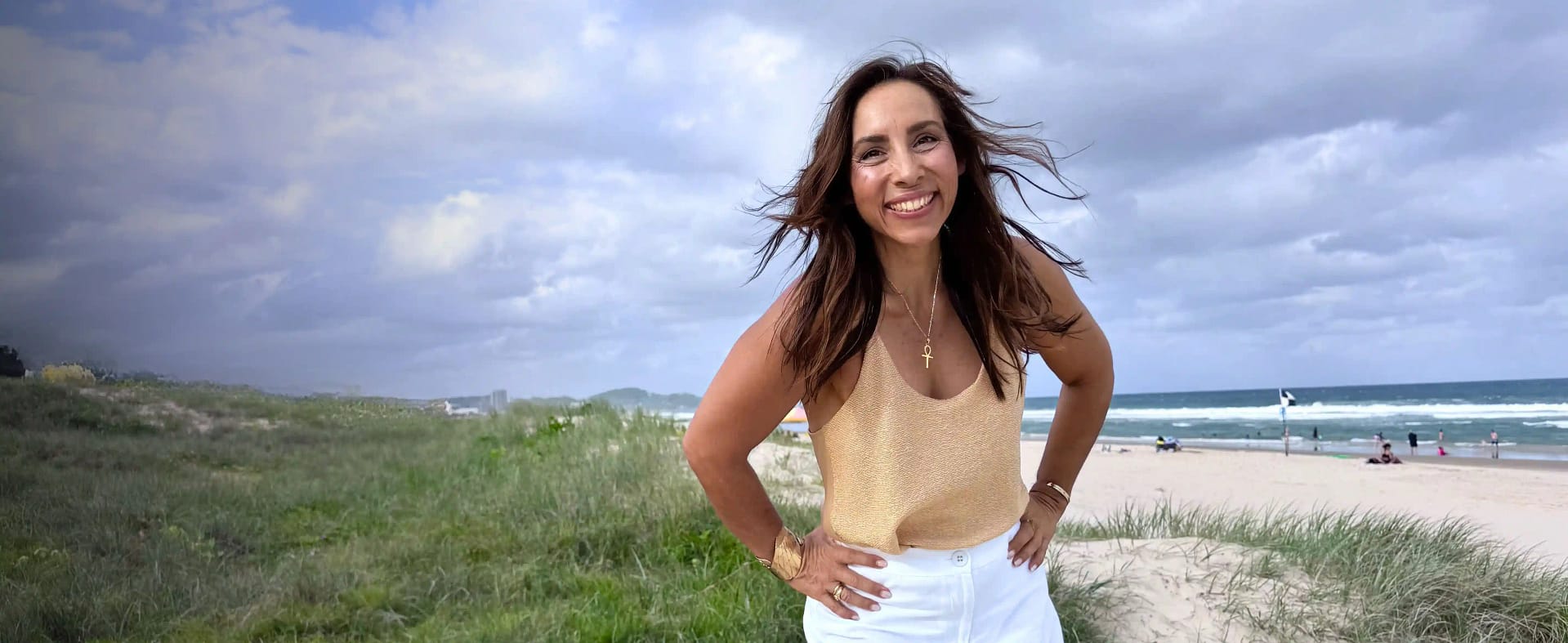
How to move beyond people-pleasing, release the guilt and create empowering boundaries in perimenopause, menopause and beyond.
—-
*Special Gift Inside*
Free guided meditation “The Energetic Shift”
I believe there’s a reckoning at midlife.
A visceral bubbling from somewhere deep within. A rising yearning. An unlabelled irritability. A desperate plea from our soul to stop being everything for everyone.
It’s time to unravel the binding cords, dismantle the protective walls and lower the drawbridge over the deep moat surrounding our own inner castle of desires.
It’s time to uncover the sovereign you: the real you, the woman beneath the roles, responsibilities and expectations.
To answer those unanswered, proverbial questions:
Who am I? What do I truly want? And how do I even begin becoming her?
We often don’t realise that, despite our best intentions to please, care for and succeed, we have worked ourselves into a well-defined box.
A box that dictates who we are, how we should act and the choices we make.
We imprison ourselves within a tight little space, with blurred lines around our personal boundaries. And eventually, that can manifest as exhaustion, burnout and rage. Sometimes it shows up as a rising level of illness or injury, or a vague sense that there is something wrong… or that something is missing.
The crazy thing is, it’s often not a tyrant outside us holding the keys to our four-walled prison.
It’s a self-perpetuating inner patriarch holding our true desires captive.
So, I invite you to break out of the illusionary safety of the box and begin recreating more empowering midlife boundaries.
What does this invisible box look like?
Do any of these examples sound familiar?
You rarely make time for yourself
You’re so busy with work and family that you seldom make time to catch up with girlfriends, enjoy a night out, take a getaway or do something leisurely simply because you want to.
You’re quick to cancel something for yourself if work or family needs arise.
You yearn for more joy, fun and friendship. There may be a feeling of loneliness, even when you’re surrounded by others. Life can begin to feel like a Groundhog Day existence.
You are always the one helping others
You help others all the time, over-giving your time and energy because other people need you.
You trade your own needs and wants for theirs. You people-please.
Perhaps you yearn to feel loved and needed by your friends and family. You may long for that picture-perfect group of girlfriends or a large, happy and connected family unit.
Instead, you feel resentful, unappreciated, used and exhausted.
You may even wonder, Who am I when I’m not being there for everyone else?
You mute your own voice
You censor your needs and desires because you don’t want to threaten or upset others, rock the boat or make someone uncomfortable.
Whether it’s your teenager, your husband, a friend or your in-laws, you fear upsetting the relationship. You fear being judged, rejected or cast out.
This constant walking on eggshells can leave you feeling hurt, angry and unheard. You may feel undervalued, emotionally depleted or conditionally loved.
You allow others to misuse your time and talents
Perhaps you undercharge for your services or products. You allow clients or customers to cancel, not show up or reschedule repeatedly without consequence.
You give away your gifts and talents to people who don’t appreciate them, while still expecting more from you.
You feel betrayed, misunderstood and undervalued. There is a yearning for something that is missing: a deeper sense of purpose, fulfilment and self-respect.

The damaging downfall of blurred boundaries
When we don’t address our blurred boundaries, the pressure can build.
It can lead to relationship difficulties, anxiety, low mood, quiet desperation and persistent guilt for wanting more than we currently have.
Sometimes we keep filling the pain with more activity, busyness or unhealthy habits. Anything that helps us avoid the deeper truth: we are pretending to be someone we are not and ignoring what we genuinely need.
If you’re reading this thinking, Yes, this sounds like me, consider sitting quietly with these questions. You might like to journal your responses or reflect on them during meditation:
– What currently owns me in my life?
– What am I trying to prove?
– What drives my busyness, actions and choices?
– Am I making decisions based on the past, other people’s expectations or old patterns?
– Or am I allowing my wiser, more authentic self to guide me in the present moment?
How did this all begin?
I love this excerpt from The Heroine’s Journey by Maureen Murdock. She writes about how the “rules” for females have remained much the same since the 1950s:
“Be attractive, be a lady, be unselfish and of service, make relationships work and be competent without complaint.”
She continues:
“We all know young girls who are full of life and vitality at 8, 9 and 10, tomboys who love to climb trees, express their opinions, explore the natural world, and share their optimism. These same girls become mere shadows of their former selves as they enter adolescence. They deny their true gifts and their true nature as they adopt false selves to please the adult culture.”
Girls come of age in a culture where men have traditionally held most of the political and economic power. We are taught to sacrifice parts of ourselves: to shrink our souls, our voices and even our bodies to fit an acceptable size.
We stop asking, Who am I? What do I want?
Instead, we start asking:
What must I do to please others?
We watch television, films and social media. We see women sexualised and objectified, their bodies marketed to sell everything from cars to toothpaste. So, we try to conform to cultural images of the “ideal” woman.
Over time, we can lose trust in our own intuition, needs and desires.
My younger self and the beginning of blurred boundaries
I remember being eight, nine or ten years old. When visitors came to our home, I was encouraged by my parents to smile, be nice and give them a hug.
“Do the right thing,” was the message.
I distinctly remember a few occasions when a certain family friend visited. I had a very strong inner feeling that I didn’t feel comfortable around this man. I felt repelled.
But despite my feelings, I was encouraged to hug him and allow him to take videos and photographs of me, all in the name of family love and connection.
I remember wondering why my parents would make me do something I really didn’t want to do.
I’ve heard so many other women retell similar stories: moments when they were taught to disregard their own boundaries for the sake of somebody else’s expectations or needs.
And boom…
That can be the beginning of people-pleasing and betraying our own boundaries.
Midlife offers us an invitation to reconnect with that inner eight-, nine- or ten-year-old girl and ask her:
– What do you really want?
– What does your intuition tell you?
– What are your true passions?
– How do you want to express yourself creatively?
– What would make you feel free, joyful and alive?
Transforming my midlife boundaries
In my early forties, I felt lost. I wanted more from life, but I felt trapped, wondering:
Is this it? Who am I? What am I here for?
I sought out an amazing spiritual coach and soul guide, with whom I worked over a number of years while moving through my own midlife awakening.
Through that work, I began to see where I was making myself small and why, without even realising it.
I saw where I had kept myself in a box I didn’t know I was in. I saw where I punished, betrayed and denied myself because of expectations I believed I needed to meet.
I saw where I allowed others to take advantage of me, bully me and walk over my boundaries. I saw how I allowed damaging labels, given to me by others, to limit and hold me back.
With her support, I began to let go of who I thought I should be and explore all the ways I could be, and more.
I found a laser-sharp, uncompromising clarity.
I found my own rewarding lane: a way to serve myself and others simply by being me.
Defining my own boundaries was essential.
Setting a boundary doesn’t have to feel aggressive
Sometimes we fear that setting boundaries will make us seem aggressive, difficult or selfish.
But boundaries can be communicated gently.
When deciding on a boundary, consider what compromise or flexibility you are genuinely willing to allow. The key is to choose that flexibility consciously, rather than abandoning your needs altogether.
When my son was a fussy toddler, he could become very defiant about what he wanted to wear. To avoid a meltdown on either side, I would suggest the clothes I would like him to wear and then offer him a choice of two alternatives.
Offering him a choice was often all he needed to feel a sense of control. The meltdown was avoided, while my needs were still met.
We can sometimes use a similar approach with adults.
For example, perhaps you only want to client accept meetings after 10 a.m. on a weekday so you can be in your best state for working with others. However, you might be willing to accept an earlier time on a Wednesday or Thursday, when you have more support and preparation time.
You set the boundary first. Then you decide where flexibility is appropriate.
The thing about healthy boundaries is that they are about finding the middle ground. Not the extreme of only doing what you want, and not the extreme of only doing what others want.
It’s about finding where both people’s needs can be acknowledged.
It’s about being assertive with your needs and desires without needing to control someone else.
How do you work out what your boundaries are?
Clients have asked me this many times, especially when they are used to pleasing others and not used to receiving.
We can become so caught up in making choices based on what has always been expected of us that we forget to say no or create a limit — until it’s too late.
Many of us are unconsciously walking around as highly programmed versions of ourselves.
Our decisions may be influenced by:
– Our parents and teachers
– Employers and workplace culture
– Society’s expectations
– Ancestral patterns
– Traumatic experiences
– Religious beliefs
– Old promises, vows or roles
– The fear of disappointing other people
These influences can limit or hide our own authentic beliefs and needs.
Defining your boundaries starts with knowing your desires and unique personal values.
I’m not talking about socially accepted values such as “family first”, “work hard” or “be kind”. Those can be important, but they may not tell the whole story.
I’m talking about your own personal checklist: the values that help you feel in alignment with your heart and soul.
These values can help you make choices that prevent you from abandoning or sabotaging yourself. Instead, they become your compass towards passion, enjoyment and a deeper sense of purpose.
When we tune into our authentic personal values, they become a powerful way to:
– Communicate our needs and wants
– Resolve conflict
– Set healthy boundaries
– Understand and honour our feelings
– Make more aligned choices
– Rebuild self-trust and self-worth
A client story: rediscovering boundaries in midlife

Let me share a client story with you.
When Ellen came to see me, she felt shamed and betrayed by friends. She was hurt and anxious, and felt directionless, as though she hadn’t yet arrived at her full contribution in life.
She knew she was keeping her true self hidden. Her life was dictated more by the needs and judgements of others, including friends, her husband and her sister-in-law.
She recognised that she was stuck in a pattern of people-pleasing and giving her power away to keep the peace or make herself feel valued. But she believed that was simply who she was.
She knew something needed to change, but she didn’t yet have the tools to create a new way forward.
Together, we labelled her anxiety and uncovered how she was trapping herself and giving her power away. We explored how she was compromising herself for others, and what was missing for her to heal and rebalance her life.
We uncovered her unique values and true desires through a personalised elicitation process. We identified her allies and adversaries, her greatest fears and, most importantly, how to create empowering boundaries.
She began to see real improvements in the way she interacted with others, and in the way they responded to her.
She developed a personalised compass to help her find her true path and purpose, and to make more aligned decisions and choices.
As her coach and mentor, it was incredibly rewarding to hear her say:
“I feel so alive, so happy, on a high and so grateful. I’m looking forward to our girls’ trip now”
Ellen rediscovered her boundaries and became more confident about creating and communicating them with others.
My midlife rebellion: learning to respect my own limits
I often labelled myself a Type A personality: a behavioural pattern associated with high achievement, intense competitiveness, time urgency and a drive for perfection.
These qualities can be useful. They can support leadership, organisation, productivity and the ability to meet tight deadlines.
But when our self-worth becomes tied to productivity, the same qualities can contribute to chronic stress, work-life imbalance, burnout and relationship strain.
When I was younger and motivated, I could push through.
I worked more hours and stayed up later. I multitasked, swallowed my frustrations and took on other people’s work to get things done.
It became a vicious cycle. Because I was someone who got the job done, I was often given even more work and higher expectations.
When I ran my own business, I became CEO, CFO, COO and CMO — every role in one body — while still expecting myself to meet tighter deadlines for a fraction of the pay.
And I was also a multitasking mum, wife, house cleaner and daughter.
CEO of our own family unit.
How do we do it?
Well, we can… until we can’t.
My worth was tied up with my success, the value I provided to others, the difference I made, the experiences I created, the success of my children, the success of my husband, doing the right thing and being a good citizen.
And, of course, the praise and feedback of other people.
Sounds exhausting, doesn’t it?
Those of us with strong Type A tendencies can thrive on people-pleasing, conflict avoidance and taking on more than we can chew. We say yes when we really should say no.
We blur the boundaries around self-care and self-worth.
I felt guilty if I stopped, rested, took a holiday or — heaven forbid — asked for help.
I worried I would be seen as a failure. I judged myself for sitting around when there was still work to be done, especially when my earnings took a nosedive after I left the corporate world to create more work-life balance and be there for my family.
Sound familiar?
I had a sneaky suspicion I was entering perimenopause when I began experiencing a constant state of exhaustion, lingering burnout and bubbling rage.
I carried an invisible mental, emotional and physical responsibility for everyone and everything. I became sick or injured more often and had a vague sense that something was wrong.
I began questioning whether I was still up for all of this and whether it was time to jump ship.
During perimenopause and menopause, hormonal changes can affect our energy, sleep, mood, concentration and physical wellbeing. Our vitality can feel different. Brain fog may appear. Pain can creep into our muscles and joints. Sleep may become disrupted, and the battery that once seemed endlessly rechargeable may no longer recover as quickly.
My body was literally making it harder for me to keep pushing on.

How I began creating more empowering boundaries
- Client boundaries
One of the first areas I changed was my work.
A lack of feeling understood and valued had kept me from charging what I was worth.
I allowed clients to cancel or not show up. I let people reschedule time and time again. I allowed voucher expiry dates to pass, made myself available outside my preferred hours, agreed to reduce my prices and tolerated late payments.
By becoming clear about my personal values and true purpose, I changed the way I offered my services.
I charged what my work was worth. I created a cancellation policy. I became prepared to walk away if my boundaries were not respected.
I realised that my time, energy and opportunity to work with soul-aligned clients were more important to my joy, meaning and sense of purpose.
- Boundaries with my teenager
I also had to create boundaries with my teenage son.
I read a social media post recently that said “having a teenage son can feel like trying to work out whether he’s mad at you, mad at school, mad at himself, mad about his hair… or simply hungry.” Absolutely!
You begin wondering, Is he shutting me out?
Independence can look like rejection before it looks like growth.
Knowing this, I held back my hurt and loving advice. I allowed him to snap at me, and I found myself walking on eggshells around his moods.
But I began to experience a high level of anxiety and low mood because I was repressing my own pain and hurt.
So I invited a non-judgemental discussion. I wanted us both to be heard. I explained my intentions and opened a conversation about how we might treat each other more respectfully as we navigated this transitional time.
The result has been that he is more open and forthcoming with his needs and desires. I allow him space to process his own big feelings.
We don’t always respond perfectly. But there is more fun, laughter and loving communication between us again.
If you stumble, you can begin again
The thing about boundaries is that we may still feel guilty when we choose ourselves, take a rest or say no.
But in those moments, we need to ask:
- Whose voice is telling me that I am wrong, selfish or mean?
- Is it your own voice?
- Or is it the old voice that says you must keep everyone happy?
Remember, you can care about someone’s feelings without taking responsibility for managing them.
You can disappoint someone without harming them.
You can be loving and still say no.
You can be kind and still have limits.
And you can stop handing responsibility for your self-worth to the person who is upset by your boundary.
It can also be confusing to reclaim our own boundaries, if we are unsure of what our own needs, desires, hobbies and passions are?
Perhaps it is time to change the story and rediscover our unique values and purpose, so there is conviction behind our choices.
An empowered boldness.
A quiet confidence.
A deeper trust in ourselves.
The energetic shift: healing and reclaiming self-care
Another area I work with clients on is the energetic level.
Often, we understand logically where we are out of alignment and what needs to change. Yet we still can’t seem to shift the guilt, habit or fear.
I work with a client’s energy body, including the chakras, to help engage with the deeper energetic patterns beneath the behaviour.
After all, we have all heard that we attract what we give our energy to.
On a basic level, we feel our desires, needs and boundaries in our bodies.
For example, when balanced, the throat chakra can be act as our sword of truth: in the way we express ourselves. It gives voice to the needs of the root chakra (our physical body ), the sacral chakra (our emotions and desires), the heart chakra (our authentic love and compassion), and the third eye (our truth and intuition).
Together with the solar plexus – our power centre that acts as our inner cheerleader, helping us step forward in our own authority, we have the inner technology to listen to our own needs and speak up, take action on that guidance.
Our energy body can tell us when we are acting from our own power, giving our power away or allowing ourselves to be taken advantage of.
When we truly listen to our energy body and respond appropriately we feel more alive, more aligned and grounded in who we are.
I work with clients to reconnect with their energy body, rebalance their chakras and raise their vibration, helping them rebuild self-trust and self-worth so they can make more empowering life choices.
I have created a free Guided Meditation called “The Energetic Shift: A Guided Chakra Meditation for Clarity, Boundaries & Self-Trust” to help you reconnect with your inner guidance and explore clarity, boundaries, self-worth, self-care, self-trust, and purpose in a gentle, heart-centered way.
Your midlife invitation
Midlife is not a punishment for everything you have done wrong.
It is not a sign that you are failing.
It may be an invitation to stop living solely from duty, expectation and old programming.
Perimenopause, menopause and the years beyond can bring uncomfortable changes, but they can also illuminate what is no longer sustainable.
The exhaustion, resentment, irritability or yearning may be carrying an important message.
Perhaps your body and soul are asking you to come home to yourself.
To listen to your intuition.
To honour your limits.
To stop abandoning your own needs in order to keep everybody else comfortable.
Creating healthy midlife boundaries is not about becoming hard, cold or selfish.
It is about becoming honest.
It is about knowing what matters to you and communicating it with courage and compassion.
It is about releasing people-pleasing and the guilt that comes with choosing yourself.
And perhaps, most importantly, it is about remembering that the woman you are becoming has been there all along.
She has simply been waiting for you to listen.
Final invitation
I’d like you to think of one area of your life where you are ready to create a healthier boundary.
You might complete these sentences:
I am currently tolerating…
What I actually need is…
One small boundary I can create is…
It doesn’t have to be dramatic.
Perhaps it’s taking time before answering a request.
Perhaps it’s asking for help.
Perhaps it’s making an appointment for yourself and keeping it.
Perhaps it’s deciding not to answer work messages after a particular time.
Or perhaps it’s simply saying:
“Let me think about that.”
That can be a very powerful sentence.
Want a little help?
Download my free Soul Alignment Meditation to calm your nervous system and hear your needs and desires more clearly.
Or book your own Soul Mastery Coaching session If you would like to work with me more deeply around boundaries, self-worth, purpose and reconnecting with the woman you are becoming.
It would be my honour and pleasure to help guide and support you into an empowering new second half of your life.

Author
-
 View all posts
I help women over 40 reclaim their happiness, freedom, and inner power as they step into the next phase of life.